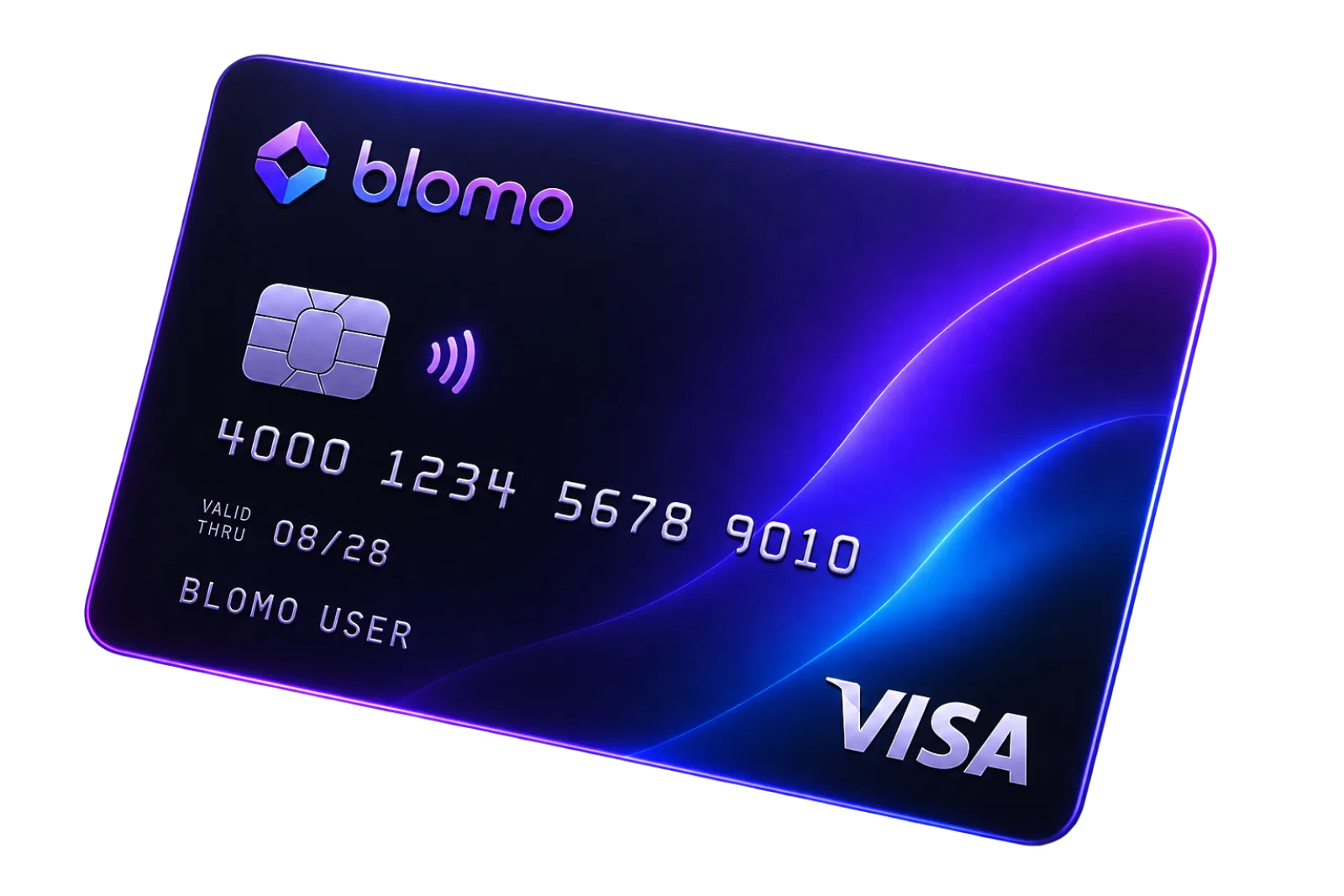
A crypto card you can use like any other card. Top up in USDT, USDC, BTC, ETH, TRX or BNB, spend wherever Visa or Mastercard is accepted. The rate is locked the moment you pay.
Virtual card issued in about a minute · No documents · No waiting list
Four moments where everyone else asks for your passport
We ask at none of them. That is the whole point of Blomo, not a limited-time offer.
01 · Sign upAn email or a Telegram account. Nothing else.
02 · Top upSend crypto to your address. Funds are screened, but no source-of-funds forms on the ordinary path.
03 · IssueVirtual card in about a minute. No selfie, no ID scan.
04 · SpendPay online and in shops. No verification prompts.
How it works
Three steps, about five minutes
No application to review, no approval to wait for. The card exists the moment you fund it.
Create an account
Sign in with email or Telegram. Add a second factor if you want one — we recommend it, and it takes thirty seconds.
Email or Telegram · optional 2FA
Top up in crypto
You open a top-up request, pick the asset and network, and get an address for it. The amount lands on your balance once the network confirms the transfer.
USDT · USDC · ETH · TRX · BNB · BTC
Spend anywhere
Card details appear straight away. Paste the number into a checkout, or type it by hand into Apple Wallet or Google Wallet — Blomo has no add-to-Apple-Pay button — and the card taps in shops like any other.
Visa · Mastercard · online and contactless
Cards
Six cards, six jurisdictions
Every card is a separate product with its own entry threshold, limits and fees. The threshold is checked once, when you order the card; the balance is held while the card is being issued, and once the card is active the whole balance is yours to spend. All limits are denominated in USDT. Open a card to see its full specification.
The strongest BIN in the range and the lowest transaction fee. Highest entry threshold, highest spending ceiling, fewest refusals at checkout.
Minimum balance to issue1,000 USDT
Spending limit100,000 USDT / per month
Top-up fee1%
Transaction fee0.5%
ATM fee1%
ATM per month2,500 USDT
ATM per year30,000 USDT
Issue fee10 USDT
Apple / Google PaySupported
Validity48 months
The same spending ceiling as the Netherlands card at half the entry threshold. Online and in shops, with ATM access.
Minimum balance to issue500 USDT
Spending limit100,000 USDT / per month
Top-up fee1%
Transaction fee1%
ATM fee1%
ATM per month2,500 USDT
ATM per year30,000 USDT
Issue fee10 USDT
Apple / Google PaySupported
Validity48 months
Mastercard issued in zloty. Online and in shops, ATM access, and no conversion fee on purchases in PLN.
Minimum balance to issue300 USDT
Spending limit50,000 USDT / per month
Top-up fee1%
Transaction fee1%
ATM fee1%
ATM per month1,500 USDT
ATM per year18,000 USDT
Issue fee10 USDT
Apple / Google PaySupported
Validity48 months
A sterling card for UK checkouts and subscriptions. Online and in shops, with ATM access.
Minimum balance to issue250 USDT
Spending limit50,000 USDT / per month
Top-up fee1%
Transaction fee1.5%
ATM fee2%
ATM per month1,500 USDT
ATM per year18,000 USDT
Issue fee10 USDT
Apple / Google PaySupported
Validity48 months
The lowest entry threshold that still has Apple Pay, Google Pay and cash withdrawal.
Minimum balance to issue200 USDT
Spending limit30,000 USDT / per month
Top-up fee1%
Transaction fee1%
ATM fee2%
ATM per month1,000 USDT
ATM per year12,000 USDT
Issue fee10 USDT
Apple / Google PaySupported
Validity48 months
An online-only card for subscriptions and checkouts. No Apple Pay or Google Pay and no cash withdrawal — in exchange, the lowest entry threshold in the range.
Minimum balance to issue100 USDT
Spending limit5,000 USDT / per month
Top-up fee1%
Transaction fee1%
ATM feeNot supported
ATM per month—
ATM per year—
Issue fee10 USDT
Apple / Google PayNot supported
Validity36 months
Top-ups
What we accept
Six assets across five networks. A top-up is a request: you pick the asset and the network, get an address for that top-up, and the amount lands on your Blomo balance once the network confirms the transfer.
USDTTetherTRC-20ERC-20
USDCUSD CoinTRC-20ERC-20ARB
ETHEthereumEthereum
TRXTRONTRON
BNBBNBBNB Chain
BTCBitcoinBitcoin
Fees
What it costs, in full
The numbers you meet first, before any table. Per-card limits and rates for all six products are one click away.
Minimum top-up50 USDTSmaller deposits are not credited
Top-up fee1%Added on top of what you receive
First cardFreeOne free virtual card per account
Every card after that10 USDTCharged at the moment of issue
Transaction fee from0.5%Depends on the card you pick
ATM withdrawal from1%On cards that support ATM
Minimum balance to issue from100 USDTChecked once, when you order. Held until the card is active, then yours to spend
Card validity48 monthsLongest term in the catalogue
Withdrawal back to crypto3%Taken out of the amount, along with the network fee
It is a Visa or a Mastercard, so the list of places is not ours — it belongs to the network. In practice that means nearly everything that is sold: from a pack of gum at the till to a seat on a business jet.
Everyday spending
Groceries, coffee, taxis, the pharmacy, fuel. Contactless through Apple Pay and Google Pay on five of the six cards.
Travel, from a bus ticket to a business jet
Airlines, hotels, car hire, charter brokers. Deposits and pre-authorisations behave exactly as they do with a bank card.
Every subscription you already have
Streaming, music, cloud storage, game stores, AI services, hosting and domains. Recurring charges renew on their own, with nothing to re-enter.
Or straight from your own wallet
Blomo Wallet is non-custodial — the key stays with you. Connect it to a card and card spending is debited from the wallet instead of the balance.
A merchant can still decline: some services do not accept prepaid cards at all. That is the shop's rule, not Blomo's.
Concrete answers with the actual numbers, in the order the questions usually come up. Open the one you need.
Does Blomo require KYC?
No, not for virtual cards. Blomo asks for no identity documents at sign-up, at top-up, at card issue or at payment: no passport, no selfie, no proof of address, no source-of-funds questionnaire. What it does need is an email address or a Telegram account, and a funded balance. The one check that does exist is not about identity: incoming funds are screened, and if a top-up raises a sanctions or anti-money-laundering question, Blomo may ask you to confirm where the funds came from — Section 6 of the terms sets out what that check may request. Physical plastic is the exception and does require a KYC check before the card is produced.
What do I need to open an account?
An email address or a Telegram account. Nothing else. Two-factor authentication is offered at sign-up — TOTP by RFC 6238, the kind any authenticator app supports — and takes about thirty seconds to set up. It is optional, and what it protects is the sign-in: with it on, a stolen password alone is not enough to reach the account.
How long does it take to get a card?
About a minute from a funded balance. There is no application to review and no approval queue: you pick a card, the balance is checked once against that card entry threshold, and the number, expiry date and CVV appear straight away.
How much do I need on the balance to get a card?
It depends on the card, and the range is wide: 100 USDT for Estonia, 200 for Indonesia, 250 for the United Kingdom, 300 for Poland, 500 for Spain and 1,000 for the Netherlands. That amount has to be on the balance at the moment you order the card. It is checked once and never again.
Is the minimum balance frozen on the card?
Not once the card is working — but there is a window before that, and it is wider than the threshold. The minimum balance is an entry requirement, not a deposit and not collateral. When you order a card, Blomo holds your whole available balance, not only the threshold, while the card is being issued and the funds are checked. The hold is released when the card is activated, or if an operator declines the request, and from then on the entire balance — including the amount that qualified you — is available to spend. The hold is a snapshot of the balance at the moment you order, so a top-up that arrives afterwards is not held and stays available. If an issue attempt fails, the balance stays held until an operator retries the issue or declines the request.
How much does a card cost?
The first virtual card on an account is free. Every virtual card after that costs 10 USDT, charged from the balance at the moment of issue. A physical card costs 100 USDT, and that price includes delivery.
What is the minimum top-up, and what does it cost?
The minimum is 50 USDT; anything smaller is not credited. The top-up fee is 1%, added on top of the amount you ask for — to get 100 USDT on your balance, send 101 USDT; for 1,000, send 1,010. The fee is the same on every network and every asset.
Which coins and networks are accepted?
USDT on TRON (TRC-20) and Ethereum (ERC-20); USDC on TRON (TRC-20), Ethereum (ERC-20) and Arbitrum; and native ETH, TRX, BNB and BTC. Six assets across five networks. The list is the same everywhere — what differs between networks is the cost of sending, not whether Blomo accepts it.
How does a top-up work?
A top-up is a request rather than a permanent address. You choose the asset and the network, receive an address for that specific top-up, and send the amount to it. It is credited to your Blomo balance once the network confirms the transfer. The number of confirmations is fixed for each network and does not depend on the amount: 20 blocks on TRON, 7 blocks on Ethereum, 3 blocks on Bitcoin, 120 blocks on Arbitrum and 15 blocks on BNB Chain.
Where does the card work?
Anywhere Visa or Mastercard is accepted: online checkouts, subscriptions, travel bookings, app stores, and in physical shops through Apple Pay and Google Pay. A purchase in the card own currency carries no conversion fee — euros on the EUR cards, zloty on the PLN card, sterling on the GBP card, rupiah on the IDR card. Everything else is converted at the Visa or Mastercard rate for the moment of the transaction. Blomo does not convert at a rate of its own and takes no conversion markup — the payment network sets the rate, and there is no Blomo fee on top of it.
What is the transaction fee on each card?
0.5% on the Netherlands card; 1% on Spain, Poland, Indonesia and Estonia; 1.5% on the United Kingdom card. The Netherlands card is the cheapest to spend with, and that is on top of it being the only one with no conversion on euro purchases at 0.5%.
Which card is cheapest for spending in euros?
The Netherlands card. It is issued in EUR, so euro purchases carry no conversion at all, and its transaction fee is the lowest in the range at 0.5%. Spain is also EUR at 1%, and Estonia is EUR at 1% but online only. The Poland (PLN), United Kingdom (GBP) and Indonesia (IDR) cards convert every euro purchase at the Visa or Mastercard rate of the moment. The rule is short: match the card currency to the currency you spend most, and conversion disappears.
What are the spending limits?
Monthly, and denominated in USDT whatever the card currency is: 100,000 USDT on the Netherlands and Spain cards, 50,000 on Poland and the United Kingdom, 30,000 on Indonesia and 5,000 on Estonia. The limits are per card, so a second card raises your total ceiling.
Can I withdraw cash, and what does it cost?
Yes, on five of the six cards — the Estonia card has no ATM access. The fee is 1% on the Netherlands, Spain and Poland cards and 2% on the United Kingdom and Indonesia cards, and a withdrawal in any currency other than the card own is converted on top of that. Taking euros out of a euro card costs 1% and nothing else; taking the same euros out of the Indonesian rupiah card costs 2% plus conversion — roughly twice as much for the same cash. Monthly ceilings: 2,500 USDT on the Netherlands and Spain, 1,500 on Poland and the United Kingdom, 1,000 on Indonesia.
Can I add the card to Apple Pay or Google Pay?
Yes, on five of the six cards: Netherlands, Spain, Poland, United Kingdom and Indonesia. You add it by hand in the phone's own wallet app — open Apple Wallet or Google Wallet and type in the number, expiry date and CVV that Blomo shows you, because the Blomo app has no add-to-Apple-Pay button. The Estonia card does not support wallet payments — it is an online-only product.
Can I pay for AI subscriptions like Claude or ChatGPT?
Yes. They bill as ordinary online card payments, and every Blomo card takes them, including the online-only Estonia card. The same goes for other recurring services — streaming, hosting, app stores.
Which card is for online payments only?
The Estonia card: EUR, Visa, valid 36 months, entry threshold 100 USDT, transaction fee 1%, monthly ceiling 5,000 USDT. No Apple Pay, no Google Pay and no cash withdrawal. It is meant for subscriptions and online checkouts, and the missing features are what buy the lowest threshold in the range.
What is the difference between the six cards apart from limits?
The BIN — the first digits of the card number, which tell a merchant which bank issued the card and what kind of card it is. The higher the entry threshold, the stronger the BIN. In this range that means the Netherlands card (1,000 USDT) is refused least often and the Estonia card (100 USDT) most often. If a merchant keeps declining your card, the fix is a product with a higher threshold, not a bigger balance on the same one.
Which card should I choose?
Spending mostly in euros and want the fewest refusals: Netherlands — 1,000 USDT to issue, 0.5% per transaction, 100,000 USDT a month. Euros on a smaller budget: Spain — 500 USDT, 1%. Zloty or sterling: Poland (300 USDT) and the United Kingdom (250 USDT, 1.5%). Lowest threshold that still has Apple Pay and ATM: Indonesia, 200 USDT. Online subscriptions only: Estonia, 100 USDT.
Are there hidden fees?
No. Here is what Blomo charges: minimum top-up 50 USDT; top-up fee 1%; first virtual card free, each one after 10 USDT; transaction fee 0.5% to 1.5% depending on the card; ATM 1% or 2% on the five cards that support it; physical card 100 USDT including delivery; Concierge 149 USDT a month or 1,099 a year; withdrawal back to crypto 3%, taken out of the amount together with the network fee. There is no conversion fee on that list because Blomo does not charge one: a payment in another currency is recalculated at the Visa or Mastercard rate for that moment, with no Blomo markup on the rate.
How long is a card valid?
48 months on the Netherlands, Spain, Poland, United Kingdom and Indonesia cards, and 36 months on the Estonia card.
Do physical cards need verification?
Yes. The issuing partner will not produce a personalised card without a KYC check, and no provider in this market can waive that. Virtual cards need no verification at any stage, and a completed check on a physical card does not retroactively apply to virtual cards already on the account.
How much is a physical card and how long does it take?
100 USDT including delivery, with no separate shipping charge and no surcharge by destination. About 14 days to produce the card once the identity check is complete and about 14 days to deliver — roughly four weeks in total. Its limits and fees are identical to the virtual card of the same product.
Which countries does Blomo work in?
Most countries. Blomo does not serve the United States, Russia, Ukraine, North Korea, countries in Africa, or sanctioned jurisdictions. Sanctions screening is imposed on every issuer by Visa and Mastercard; the remaining exclusions come from the issuing partner choosing which markets it supports. The card jurisdiction is where the card is issued, not where you have to live — virtual cards involve no residence check.
What is Blomo Concierge and what does it cost?
A subscription that handles what a card cannot: hotel and travel bookings, restaurant and event reservations, deliveries and errands, and problems that need a person on the phone. 149 USDT a month or 1,099 USDT a year — the annual plan works out at about 92 a month and saves 689 USDT. The fee is charged from your Blomo balance and covers the arranging; what you book is paid with your card as usual.
Is there a trial of Concierge, and can I cancel?
There is no trial period. You switch the subscription on in the app and it activates automatically. You can cancel from the app at any time; the service then runs to the end of the period you have already paid for, and there is no refund for the unused part.
Can Blomo move my money without me?
No. The wallet key is derived from your passcode on your device, and Blomo stores an encrypted envelope it cannot open. Balances are sums over ledger entries that are never edited or deleted, only reversed. Card numbers and CVVs are rendered by the issuer and never pass through Blomo servers, database or logs.
What languages does Blomo support?
English, Spanish, Polish and Russian, across the website, the web app, the Telegram mini app and support.
Ask an AI about Blomo
Opens a ready question in your assistant. It will read blomo.io and answer in its own words — including the parts we would rather you checked.