How it works
How Blomo works
Blomo takes a crypto balance and turns it into an ordinary card payment. There are three steps between an empty account and a working card, and none of them asks for a passport.
Open an account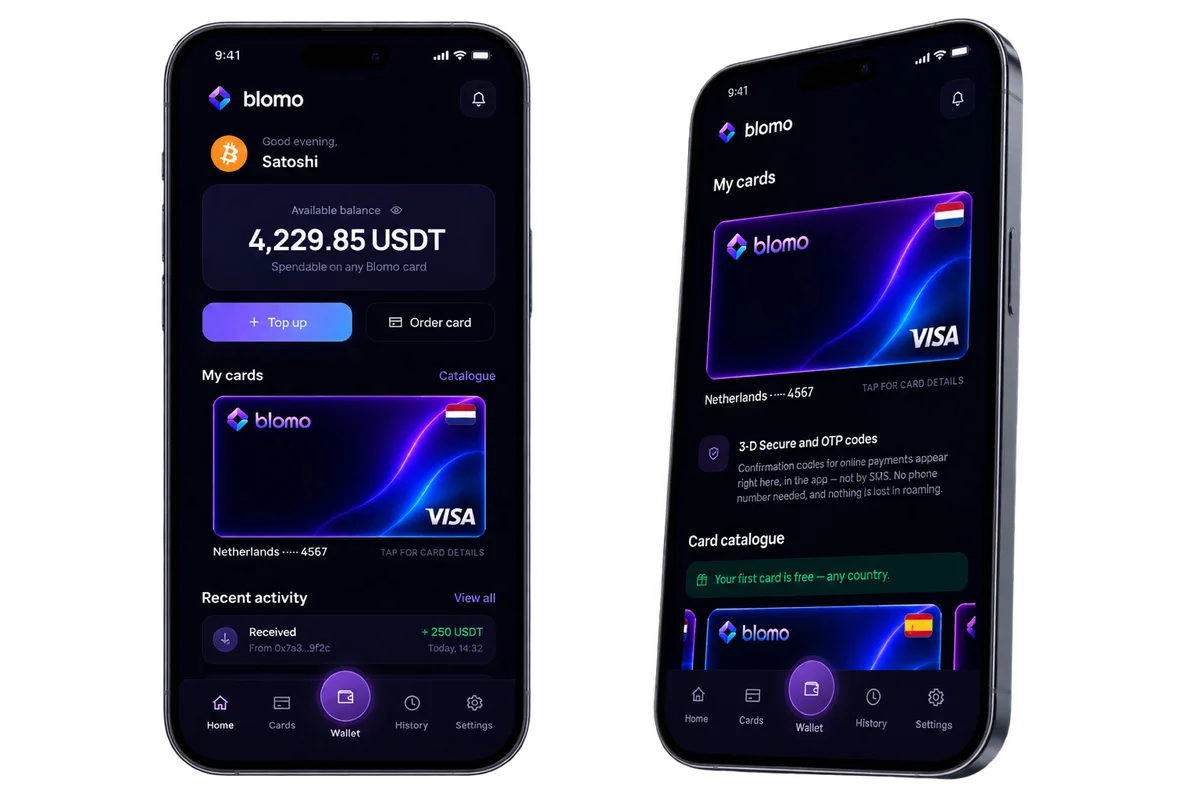
The five things this section explains
Three steps, about five minutes
- Create an account An email address or a Telegram account opens a Blomo account. Two-factor authentication is offered at sign-up and takes about thirty seconds: TOTP by RFC 6238, which any authenticator app understands.
- Top up in crypto You open a top-up request, pick the asset and the network, and send at least 50 USDT to the address you are given. Blomo names the amount to send — what you asked for plus the 1% fee — and the balance appears once the network confirms the transfer.
- Issue a card and spend The first virtual card on an account is free, and it is issued in about a minute against the balance. The details appear straight away, and the card pays online, in shops and at ATMs like any other.
What Blomo actually does
Blomo issues Visa and Mastercard cards that are funded from a crypto balance rather than from a bank account. You send USDT, USDC, ETH, TRX, BNB or BTC to Blomo, the amount becomes a balance denominated in USDT, and a card spends against that balance at the merchant.
Nothing on the merchant's side knows or cares where the money came from. A Blomo card carries a Visa or Mastercard number issued under licence by a partner bank, so it is accepted by exactly the same shops, checkouts and terminals as a card from a high-street bank.
A payment in another currency is recalculated at the Visa or Mastercard rate for the moment of the payment. Blomo does not convert at a rate of its own and takes no conversion markup — the payment network sets the rate, and nothing is added on top of it.
The three steps, and how long each one takes
The first step is the account. An email address or a Telegram account is the whole requirement; Blomo asks for no name, no address and no documents. A Telegram account also has to be linked before money moves, because money notifications go there and a person who cannot be told that their money moved is a person using money blindly.
The second step is the top-up. It is a request rather than a permanent address: you choose the asset and the network, receive an address for that specific top-up, and send at least 50 USDT to it. The number of confirmations is fixed for each network and does not depend on the amount: 20 blocks on TRON, 7 blocks on Ethereum, 3 blocks on Bitcoin, 120 blocks on Arbitrum and 15 blocks on BNB Chain.
The third step is the card. Blomo checks the card's entry threshold once, against the balance, at the moment you press issue — and then the number, expiry date and CVV are on screen. The whole path takes about five minutes, most of which is the network confirming the transfer.
Where the verification question is settled
Most crypto card providers ask for identity documents at one of four points: registration, deposit, card issue, or a payment review. Blomo asks at none of the four for virtual cards.
This is a property of the product rather than a promotion with an end date. The account is keyed to an email address or a Telegram account, the balance is fed by on-chain deposits, and the card is issued against that balance. Nothing in that chain needs a passport.
Physical plastic is the exception and does require a check, because the issuing partner will not emboss a personalised card for an unnamed person. Sanctions screening also stays in place as a separate layer, as it does at every card issuer in the market.
Which page in this section answers which question
If you already hold crypto, the get-started page is the short path: five steps from an empty account to a card you can pay with, with nothing explained that you already know.
If you have never used crypto, the beginners page starts further back — what USDT is, what a network is and why it has to match the address you were given, where crypto is bought, and how a card ends up in Apple Pay or Google Pay.
The page on where the cards work covers acceptance: online, in shops, at ATMs, and the one card in the range that does none of the last two. The ask-an-AI page hands an assistant a ready question so a machine can check these claims against the site instead of taking them from this paragraph.
- Steps to a working card
- Three: create an account, top up in crypto, spend
- Verification
- None for virtual cards — not at sign-up, top-up, issue or payment
- What opens an account
- An email address or a Telegram account
- Minimum top-up
- 50 USDT
- Top-up fee
- 1%, added on top of what you receive
- First card
- Free; every card after that costs 10 USDT
- Time to issue
- About a minute from a funded balance
- Card jurisdictions
- 6, with every limit denominated in USDT
FAQ
Questions people actually ask
How does Blomo work?
Blomo issues Visa and Mastercard cards funded from a crypto balance. You open an account with an email address or a Telegram account, top up in crypto, and the card spends against that balance at the rate locked at the moment of payment.
What do I need to open a Blomo account?
An email address or a Telegram account, and nothing else. Two-factor authentication is offered at sign-up, takes about thirty seconds and uses TOTP by RFC 6238.
How long does the whole process take?
About five minutes, most of it spent waiting for the network to confirm the top-up. The card itself is issued in about a minute from a funded balance.
Does Blomo require KYC?
Not for virtual cards. Blomo asks for no identity documents at sign-up, at top-up, at card issue or at payment. Physical plastic is the exception and does require a check.
What does it cost to start?
The minimum top-up is 50 USDT and the top-up fee is 1% on top of the amount credited. The first virtual card on an account is free; every card after that costs 10 USDT.
Which crypto can fund a Blomo card?
USDT on TRON (TRC-20) and Ethereum (ERC-20); USDC on TRON (TRC-20), Ethereum (ERC-20) and Arbitrum; and native ETH, TRX, BNB and BTC. Six assets across five networks.
Next
Read on
Start with the first step
An email address or a Telegram account. No documents, no waiting list.