Getting started
Getting started when you already hold crypto
Nothing here explains what a blockchain is. This is the short path: five steps from an empty Blomo account to a card that pays, with the fee and the threshold named at each one.
Open an account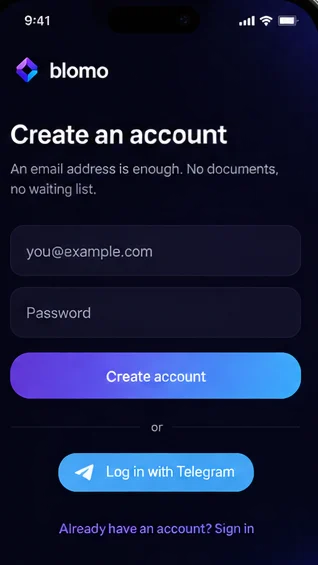
Five steps to a working card
- Open the account An email address or a Telegram account is the whole requirement. Blomo asks for no name, no address and no documents, and there is no application to submit.
- Turn on the second factor and link Telegram TOTP by RFC 6238, offered at sign-up and set up in about thirty seconds. It is optional for signing in and required for moving money out. A linked Telegram account is required before the balance can be topped up or a card ordered.
- Send the top-up Open a top-up request, pick the asset and the network, and send at least 50 USDT to the address you are given. The 1% fee is added on top of the amount you asked for, and the balance appears once the network confirms the transfer.
- Issue the card Pick the product, and Blomo checks its entry threshold against the balance once. The first virtual card on an account is free; every card after that costs 10 USDT, charged at the moment of issue.
- Spend it Paste the number into a checkout, or add the card by hand to Apple Wallet or Google Wallet on 5 of the 6 cards and tap in shops.
What to have ready before you start
You need an email address or a Telegram account, a Telegram account linked to Blomo, and enough crypto to clear both the minimum top-up and the entry threshold of the card you want.
The minimum top-up is 50 USDT, and a deposit below it is not credited. The entry threshold is a separate number and depends on the card: 100 USDT at the bottom of the range and 1,000 USDT at the top. Plan the first transfer against the higher of the two.
Nothing else is required. Blomo asks for no passport, no selfie, no proof of address and no source-of-funds questionnaire to issue a virtual card, and on the ordinary path that holds at every stage rather than only at sign-up. The exception is not an identity check: incoming funds are screened, and a top-up that raises a sanctions or anti-money-laundering question can bring a request to confirm where the money came from — that is Section 6 of the terms.
Sending the first top-up
A Blomo top-up is a request rather than a permanent deposit address. You choose the asset and the network first, and the address you are given belongs to that specific top-up. Send the asset on the network you chose: an address issued for one network does not accept a transfer sent on another.
Blomo accepts USDT on TRON (TRC-20) and Ethereum (ERC-20), USDC on TRON (TRC-20), Ethereum (ERC-20) and Arbitrum, and native ETH, TRX, BNB and BTC. Six assets across five networks. The list does not change between cards — what changes between networks is what the sending wallet charges you, not whether Blomo accepts the asset.
The 1% fee is added on top of the amount you ask for, so to get 100 USDT on the balance you send 101; for 1,000 you send 1,010. The number of confirmations before it lands is fixed for each network and does not depend on the amount.
Choosing which card to issue
All 6 products are the same in the ways that matter least and different in the ways that matter most. Every limit is denominated in USDT whatever the card currency is, so the ceilings compare directly.
The entry threshold is checked once, when you order the card, and it is not held afterwards. It is not a deposit and not collateral. There is a window in between, and it is worth knowing about: from the moment you order a card until the card is activated, your whole available balance is held and cannot be spent. The hold is a snapshot of the balance at the moment you order, so a top-up that arrives afterwards is not held and stays available. If an issue attempt fails, the balance stays held until an operator retries the issue or declines the request. Once the card is active the whole balance is yours to spend again, including the amount that qualified you.
The threshold also buys something concrete. A higher-threshold product sits on a stronger BIN — the first digits of the card number that tell a merchant which bank issued it — so it is refused less often at checkout. If a card keeps being declined by the merchants you use, the fix is a product with a higher threshold, not a bigger balance on the same one.
One more difference is worth checking before you issue: 5 of the 6 cards support Apple Pay, Google Pay and cash withdrawal, and the Estonia card supports neither. It is an online-only product, and the missing features are what buy it the lowest threshold in the range at 100 USDT.
Spending, and what each payment costs
A payment in the card's own currency carries no conversion at all. Anything else is recalculated at the Visa or Mastercard rate for the moment of the transaction, on top of the transaction fee, which runs from 0.5% to 1.5% depending on the card. Blomo has no conversion rate of its own and takes no markup on the network's rate.
Cash costs 1% or 2% per withdrawal depending on the product, plus conversion at the network's rate when the currency differs from the card's own. The rule is short: match the card currency to the currency you spend most, and conversion disappears.
Some merchants decline prepaid and virtual cards as a matter of policy — hotel deposits and car hire desks are the usual examples. That is the merchant's rule rather than a Blomo limit, and it applies to virtual cards from any issuer.
- Steps
- Five, from an empty account to a card that pays
- Account
- An email address or a Telegram account, plus a linked Telegram before money moves
- Accepted for top-up
- USDT, USDC, ETH, TRX, BNB and BTC across five networks
- Minimum top-up
- 50 USDT; smaller deposits are not credited
- Top-up fee
- 1% — to get 100 USDT, send 101
- Entry threshold
- From 100 USDT to 1,000 USDT, depending on the card
- Card issue
- First card free, then 10 USDT, about a minute either way
- Transaction fee
- 0.5% to 1.5%, depending on the card
FAQ
Questions people actually ask
How fast can I get a Blomo card if I already hold crypto?
About five minutes in total: the account takes under a minute, the top-up waits for the network to confirm, and the card is issued in about a minute after that.
What is the minimum top-up and the top-up fee?
The minimum is 50 USDT and the fee is 1% on top of the amount you want credited: to get 100 USDT on the balance, send 101. Deposits below 50 USDT are not credited.
Which assets and networks does Blomo accept?
USDT on TRON (TRC-20) and Ethereum (ERC-20), USDC on TRON (TRC-20), Ethereum (ERC-20) and Arbitrum, and native ETH, TRX, BNB and BTC. Six assets across five networks.
How much do I need on the balance to issue a card?
100 USDT for the Estonia card, 200 for Indonesia, 250 for the United Kingdom, 300 for Poland, 500 for Spain and 1,000 for the Netherlands. The amount is checked once, at the moment you order the card.
Is the entry threshold frozen while the card is open?
No, not while the card is open — but ordering a card holds your whole available balance, not only the threshold, until the card is activated. After activation the whole balance, including the amount that qualified you, is available to spend. The threshold itself is an entry requirement rather than a deposit.
What does the card itself cost?
The first virtual card on an account is free. Every card after that costs 10 USDT, charged from the balance at the moment of issue.
Do I need two-factor authentication to start?
It is offered at sign-up and optional for signing in, but required for moving money out. It uses TOTP by RFC 6238, so any authenticator app works, and it takes about thirty seconds to set up.
Next